A.W100.1 Arete logo name RGB(29,155,240) R TM SM Arete Consulting
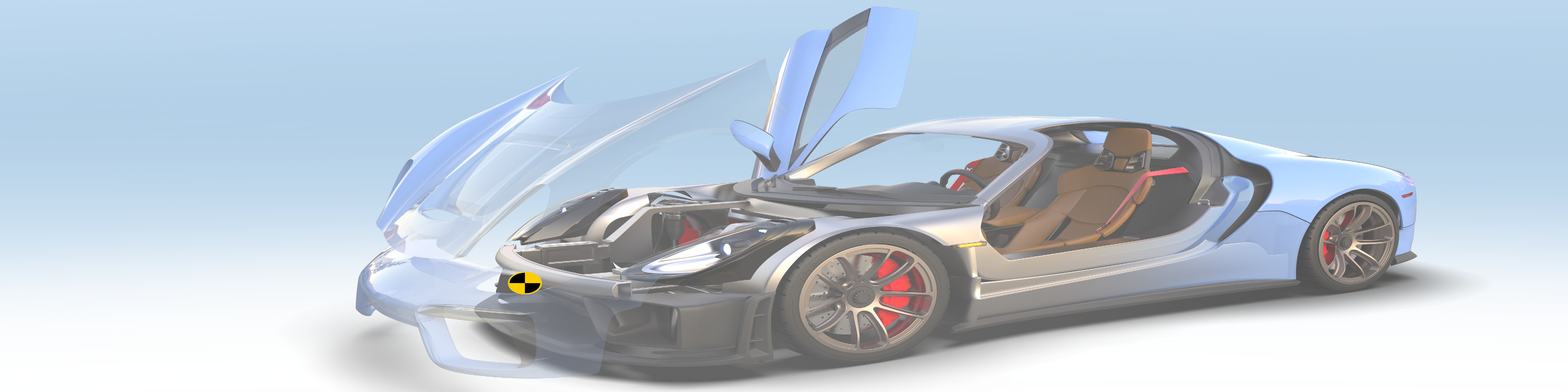
A.W122.1 AreteCutawayTransparentCar CTM US 49 CFR 571.201+ Crashworthiness 70OPACITY

     Crashworthiness

     Summaries of FMVSS 206, 207, 208, 209, and 210

49 CFR 571.206 Door Locks and Door Retention Components (FMVSS 206)

Test-Procedure TP-206-08 Quasi-Static Tension Test, TP-206I-01 Inertial Load Sled Test

FMVSS 206 requires the latches (primary and secondary latched positions) to not just hold the doors closed but must also survive a static longitudinal load of 11,000 N (2,473 lbf) and static transverse load of 4,500 or 9,000 N (1,012 or 2,023 lbf, depending on location and type of door).

FMVSS 206 requires the hinges to not just support the doors but must also survive a static longitudinal load of 11,000 N (2,473 lbf) and static transverse load of 9,000 N (2,023 lbf), and requires both hinges and latches must hold the door closed against an impact pulse of at least thirty times Unloaded Vehicle Weight (UVW) (specifically, ≥30 g), in each of the forward longitudinal direction, transverse direction, and rearward longitudinal direction.

FMVSS 206 requires that door status information must be shown on the driver display and that Speed Interlocks and Lock Overrides must both function as required.

Removable, flimsy doors will require decreased testing and complexity, whereas non-removable, less flimsy, more passenger car-like full doors with glazing will require increased testing and complexity; based on various NHTSA Interpretation Letters and the following FMVSS indicators, emphasis added:

  • 49 CFR 571.3(b) Unloaded Vehicle Weight means the weight of a vehicle with maximum capacity of all fluids necessary for operation of the vehicle, but without cargo, occupants, or accessories that are ordinarily removed from the vehicle when they are not in use.

  • 49 CFR 571.214(S5)(a)(4) Exclusions from S6 (door crush resistance). A vehicle need not meet the requirements of S6 (door crush resistance) for [...] Any side door that is designed to be easily attached to or removed (e.g., using simple hand tools such as pliers and/or a screwdriver) from a motor vehicle manufactured for operation without doors.

  • 49 CFR 571.214(S5)(b)(1) Exclusions from S7 (moving deformable barrier test). The following vehicles are excluded from S7 (moving deformable barrier test): [...] and vehicles which have no doors or exclusively have doors that are designed to be easily attached or removed so the vehicle can be operated without doors..

  • 49 CFR 571.214(S5)(c)(5) Exclusions from S9 (vehicle-to-pole test). The following vehicles are excluded from S9 (vehicle-to-pole test) [...] Vehicles that have no doors, or exclusively have doors that are designed to be easily attached or removed so that the vehicle can be operated without doors.

  • 49 CFR 571.226(S2) Application. This standard applies to passenger cars, and [...], except [...], and vehicles with no doors or with doors that are designed to be easily attached or removed so the vehicle can be operated without doors..

49 CFR 571.207 Seating Systems (FMVSS 207)

Test-Procedure TP-207-09 (TP-207-09a Part1 Quasi-Static Tension Test, TP-207-09b Part2 Data Sheets)

FMVSS 207 requires the seat and seat attachments must survive static longitudinal loads of twenty times the sum of the mass of seats, seat structure, and seat anchors (specifically, 20 g), and must survive a rotational moment of 373 N-m (275 ft-lb) in each seating position. If seatbelts are attached to the seat, the seat must survive the sum of seat belt and seat loads.

49 CFR 571.208 Occupant Crash Protection (FMVSS 208)

Test-Procedure TP-208-14 Frontal Sled Tests and Frontal Perpendicular and Angled Crash Tests using RB, SDB, and MDB, and Appendix A, B, C, D, E, F, G, H

FMVSS 208 requires that when a vehicle impacts a frontal crash barrier perpendicular to the direction of travel at a speed up to 56 kmph (35 mph), the belted Anthropomorphic Test Devices (ATD) placed in each front outboard Designated Seating Position (DSP, see also DSP Test-Procedure TP-DSP-01) must meet specific injury criteria. The same injury criteria must be met when a vehicle impacts a frontal crash barrier angled 30 degrees to the direction of travel at a speed up to 56 kmph (35 mph), with unbelted ATD placed in each front outboard DSP. Test types are dynamic: crash-test and sled-test. Barriers types are rigid (RB), stationary deformable (SDB), and moving deformable (MDB).

49 CFR 571.209 Seat Belt Assemblies (FMVSS 209)

Test-Procedure TP-209-08

FMVSS 209 requires empirical testing, certification, marking, and the basic U.S. flammability resistance requirements of 49 CFR 571.302 Flammability of Interior Materials (FMVSS 302, see Arete summary) must be performed for interior materials such as seat belt webbing and plastic housings. If the seat belt assembly manufacturer is not the same entity as the vehicle manufacturer, then the seat belt assembly manufacturer would typically assist the testing and compliance process, and then provide pass-through certification to both FMVSS 209 and 302 for the seat belt assemblies.

49 CFR 571.210 Seat Belt Assembly Anchorages (FMVSS 210)

Test-Procedure TP-210-09 (TP-210-09a Part1 Quasi-Static Tension Test, TP-210-09b Part2 Data Sheets)

FMVSS 210 requires a Type 1 or a Type 2 seat belt assembly for each Designated Seating Position (DSP, see also DSP Test-Procedure TP-DSP-01) depending on vehicle class as required by 49 CFR 571.208 Occupant Crash Protection (FMVSS 208, see Arete summary), and requires such assemblies and their anchorages, attachment hardware, and bolts must survive a static longitudinal load of 13,345 or 22,241 N (3,000 or 5,000 lbf, depending on location and type of seat belt assembly) attained within 30 seconds and maintained for 10 seconds, using a specialized pelvic body block and shoulder belt body block.

NHTSA Test Procedures

Contact

Hello@AreteConsulting.org   in

A.W130.1 Flickr - Phil Varney - Great Smoky Mtns Natl Park - Newfound Gap Road

             Photo Phil Varney

Copyright © 2021-2026 Arete Consulting. All rights reserved.

Always hand-crafted, never AI-generated.

Site Map | Attributions | Privacy Notice | Disclaimers

Using the Website means you consent to the Terms of Use.

Webpage document code: A.W230.2