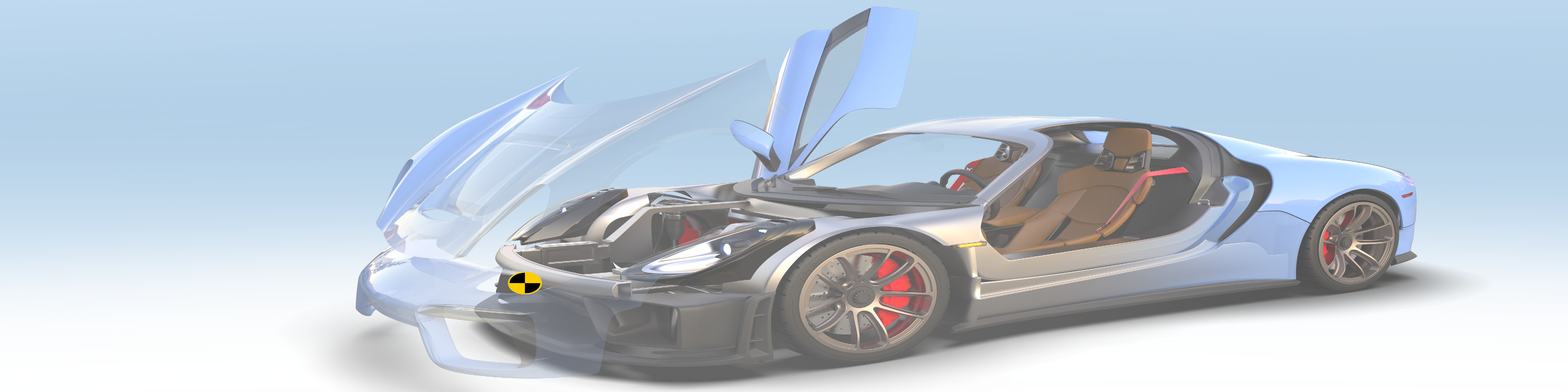
FMVSS 214 requires when the seats are removed from the vehicle: the initial door crush resistance must be more than 10,000 N (2,250 lbf), the intermediate door crush resistance must be more than 15,569 N (3,500 lbf), and the peak crush resistance must be more than two times Unloaded Vehicle Weight (UVW) (specifically, >2 g) or 31,138 N (7,000 lbf), whichever is less.
FMVSS 214 also requires when the seats are installed to the vehicle: the initial door crush resistance must be more than 10,000 N (2,250 lbf), the intermediate door crush resistance must be more than 19,460 N (4,375 lbf), and the peak crush resistance must be more than two times UVW (specifically, >2 g) or 53,378 N (12,000 lbf), whichever is less.
Test types are quasi-static door crush resistance, and dynamic: crash-test and sled-test. Barriers types are Fixed, Rigid Pole (FRP) and Moving Deformable (MDB). During dynamic crash testing, where Anthropomophic Test Devices (ATD) (50%-ile male, and 5%-ile female) seated in a vehicle must not exceed specified values for peak lateral acceleration of the pelvis and Thoracic Trauma Index (TTI(d)), when the vehicle is impacted at 53 kmph (33.5 mph) by an MDB, and again when impacted at 32 kmph (20 mph) into an FRP.
FMVSS 214 requires doors to remain attached, hinged, and latched during all dynamic crash testing. However, FMVSS 214 does not apply to vehicles with no doors or with doors that are designed to be easily attached or removed, or any side door that is designed to be easily attached or removed.
 R TM SM.png)